AI in Marketing
It’s a tool, not a brain replacement.
AI is everywhere right now. You can’t scroll, search, or sit through a webinar without someone telling you how it’s going to save you time, money, and sanity. And let’s not forget how AI in marketing means you can basically just ask GPT and then sit there with your feet up watching the money roll in. (You can’t by the way—this is utter nonsense!)
And look, I’m not here to shame AI. I use it. Most marketers do. Used properly, it can be an incredibly powerful tool. But there’s a big difference between using AI and handing over your entire marketing brain to it.
Because while AI can help you massively, it can also quietly ruin your business if you overuse it, trust it blindly, and stop thinking for yourself.
So let’s talk about where AI fits, where it absolutely doesn’t, and what it’s already changed in marketing. It evolves so quickly by the time I publish this blog I will probably have to add to it!
What AI in Marketing Can Do (And Do Well)
AI is brilliant at speeding things up. That’s where its real value lies.
It can help you get ideas down when your brain is foggy, give you a starting point when you’re staring at a blank screen, summarise information quickly, spot patterns in data, and take repetitive tasks off your plate. If you’re short on time (and let’s be honest, most business owners are), AI can be a lifesaver.
It’s also useful for things like analysing performance, pulling together reports, repurposing content, or helping you organise your thoughts before you turn them into something usable.
The key thing to understand is this: AI works best when it’s supporting your thinking, not replacing it.
It’s an assistant. Not a strategist. Not a brand expert. And definitely not the voice of your business.
Where Things Start to Go Wrong
Problems creep in when AI stops being a tool and starts being the decision-maker.
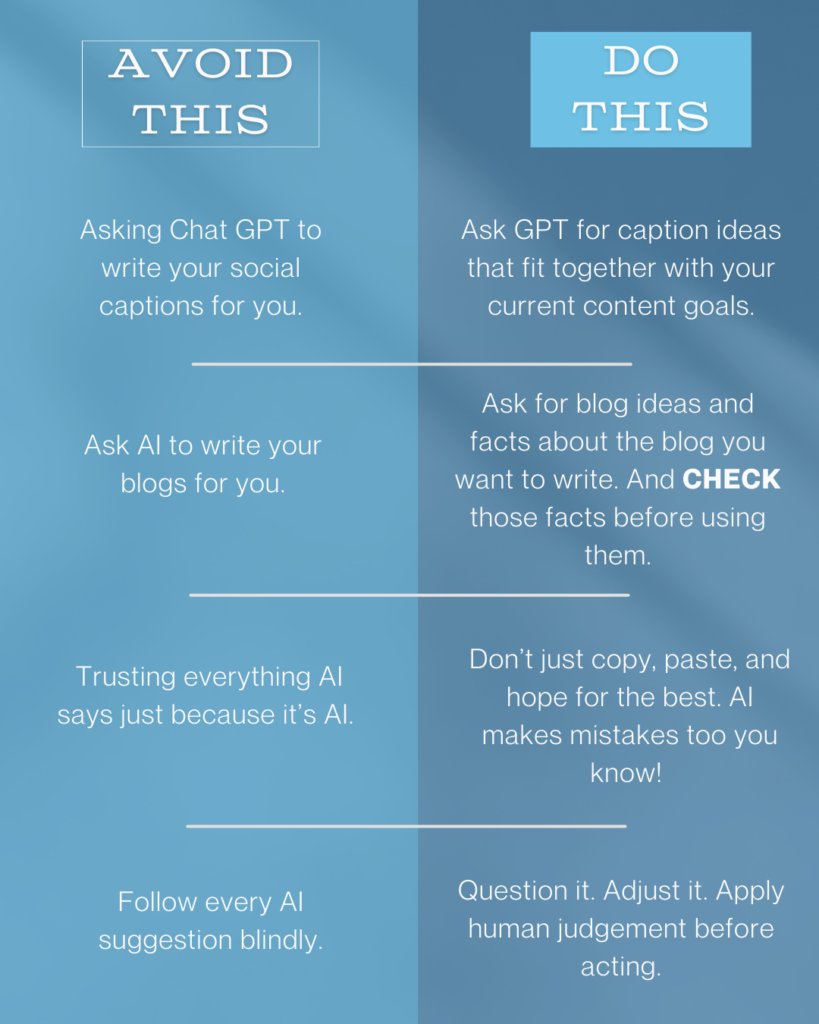
I see it all the time and spot it a mile off! Blogs, captions, emails, even full websites that are clearly AI-written and barely touched by a human. They’re not wrong exactly. They’re just rather empty. Polished, generic, and completely forgettable.
The issue isn’t that AI is being used. It’s that people are using it without questioning it.
AI doesn’t know your customers.
It doesn’t understand your tone.
It doesn’t have opinions.
It doesn’t know what makes your business different.
And it definitely doesn’t know what your audience actually cares about unless you tell it…and even then, it can only guess.
When you rely on it too heavily, a few things tend to happen. Your content starts sounding like everyone else’s. Your personality disappears. You stop thinking strategically about what you’re saying and why you’re saying it. And slowly, without realising it, your marketing loses impact.
This is where AI can do real damage. Not in a dramatic, overnight way, but in a slow, creeping, “why isn’t this working anymore?” kind of way.
Why Overusing AI in Marketing Can Hurt Your Business
Marketing works when people trust you. Trust comes from clarity, honesty, and feeling like there’s a real human behind the business.
When AI is overused, that human element fades. Content becomes safe, neutral, and overly balanced. Nothing stands out. Nothing challenges. Nothing sticks.
And here’s the big one that people don’t talk about enough: when you let AI do all the thinking, you stop learning. You stop understanding your audience. You stop spotting patterns yourself. You stop refining your message. You’re just publishing words and hoping for the best.
AI can’t replace judgment. It can’t replace experience. And it can’t replace knowing your own business.
AI in Marketing and the Changes I’ve Seen
One of the biggest shifts AI has brought isn’t content creation it’s how people search for information.
We’re no longer in a world where everyone just “Googles it”. People are asking questions directly to AI tools. They’re using voice search. They’re looking for answers that are clear, direct, and genuinely helpful.
Which means marketing has shifted.
Content can no longer just about SEO. It has to actually answer questions properly. It has to make sense. It has to sound human. And it has to be useful enough that AI tools are confident pulling from it and referencing it.
This doesn’t mean SEO is dead — far from it. But it does mean it’s evolving.
Beyond SEO: Optimising for AI
This part is well beyond entry-level marketing, but it’s important to understand where things are heading.
It’s no longer just about optimising for search engines. You also need to think about how AI tools read, interpret, and surface content.
This means your content needs to be clear and well-structured, written in natural language, focused on genuinely answering real questions, and it must be trustworthy, consistent, and accurate.
AI tools prioritise clarity and usefulness, not keyword-stuffed waffle. The better your content explains something, the more likely it is to be surfaced; whether that’s on Google, in AI search results, or through voice assistants.
This is exactly why human-led thinking matters more than ever. AI might change the platforms, but good content fundamentals still win.
AI in Marketing Wrapped Up
AI isn’t the enemy. But it’s also not the solution to bad marketing.
If you use it to save time, support your ideas, and make your work more efficient, that’s great.
If you use it to avoid thinking, avoid strategy, and avoid finding your own voice, that’s where things fall apart.
Marketing still comes down to understanding people, communicating clearly, and building trust over time. No tool can do that for you.
Use AI wisely. Question it. Edit it. Challenge it.
And always, always keep your brain switched on.
If you’re unsure how AI fits into your marketing without stripping away your personality, or you feel like your content has started sounding a bit beige lately, that’s usually a sign something needs rebalancing.
And if you want help finding that balance you know where to find me.
To keep up to date, be sure to follow Direct Pulse on Facebook and Instagram by clicking the links below.